
VI · Coming into the Process
Words 36 · RF@80 Series. Keynote Accompanying Notes Part 6 of 7 – Alexander Technique Congress. August 4th. 2025. Dublin.

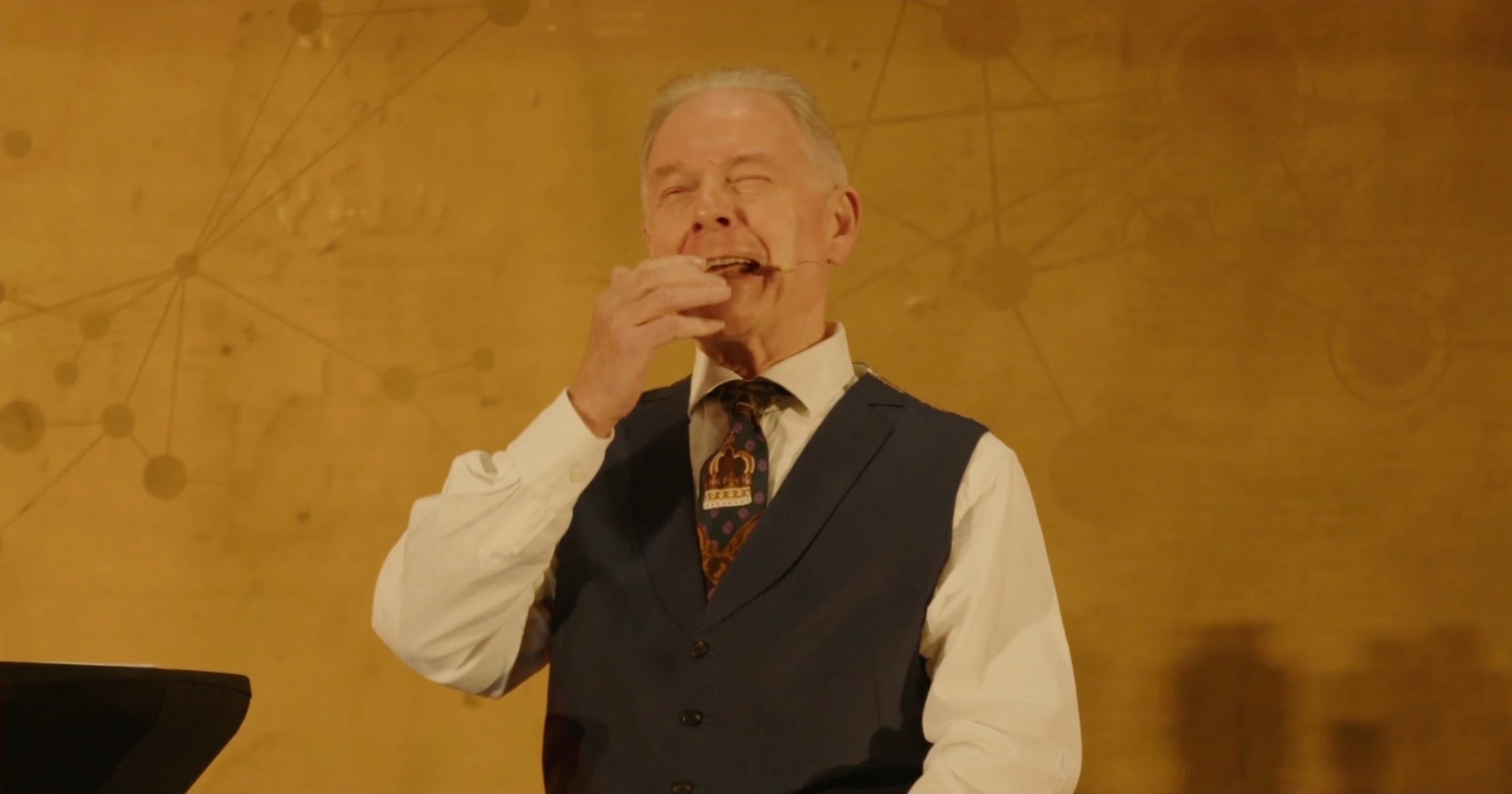
Coming into the space, coming into the room, engaging our active attention and coming into ourselves, coming into the event, we now come into the process.
Coming into the process, we begin where we are, moving from a Still Point.
Any process has three stages: the beginning, the middle and the end. Each of these three stages also has three stages, giving nine distinct qualitative points: The beginning of the beginning, the middle of the beginning, the end of the beginning. The beginning of the middle, the middle of the middle, and the end of the middle. The beginning of the end, the middle of the end, and the end of the end.
The beginning is half of the whole, according to Pythagoras. So, a sound beginning will take us as far as the middle. In the middle is the Great Divide: too far from the beginning to go back, too far from the end to go forward – this is the Liminal Zone of any process.
Each of the three main stages have their own Liminal Zones: characterised by ambiguity, hazard and opportunity. There is no inevitability, no guarantee, that the process will succeed merely by continuing in motion. There are weak moments at certain points in the process, when the process may go off course. These ‘weak moments’ require intervention, adjustment, and re-direction to maintain the trajectory of the process.
There are three qualities of time at work in a process: sequential clock time, eternity and hyparxis, or Creative Time. We may experience these as one thing after another, synchronicity or potential, and the Timeless Moment.
Creative Time is timeless. This is where decision, choice and commitment have effect within a process. Which we bring to bear on the ‘weak moments’ to adjust and re-direct when the process is likely to go off course.
Creative Time is non-causal. In Creative Time, the end may reach back and set the beginning in motion.
There are three qualities of ending: a finish, a conclusion, or a completion. With a finish, something is lost. With a conclusion, nothing much has changed. With a completion, there is a new beginning.
A characteristic of completion is transformation. Something is not what it was as it began (noting that neither is it otherwise). A particular quality has entered into the process, which was either not there at the beginning, or was a potential waiting to be actualised. The transformation is ontological: there is a change in being. For example, sounds become notes, notes become music. Instrumentalists become musicians. Even guitarists who began tone deaf and with no sense of rhythm.
A learning process has the three primary stages of injunction, application and verification. We are given instruction, and may or may not be willing and able to receive it. We apply ourselves to internalising, and making our own, what we are taught. Then we present our work to those sufficiently qualified to judge the quality of our work. In the verification, or assessment stage, of our nine distinct qualitative points: Point Seven is validation. The question is, does this work? Philologically, is this strong? Point Eight is verification. Philologically, is this true? At Point Nine, the process ends. This may be a finish, a conclusion, or a completion.
A Musician’s Process. The first overall stage is learning the instrument. The second overall stage is learning the notes, the repertoire. The third overall stage is learning the music.
In the first overall stage: The beginning of the beginning, we act on the instrument from the outside. The middle of the beginning, we move inside the instrument. The end of the beginning, the instrument becomes an extension of our body.
In the second overall stage: We play the notes. We move inside the notes. The notes move inside us.
In the third overall stage: We play the music. We move inside the music. The music moves inside us.
A Performance Process. The beginning of the third overall stage is when the audience walks in the room. An ideal audience is sufficiently competent to judge the merits of the performer. For the performer, there is nothing like exposure to public ridicule to galvanise the attention.
There are seven levels of geographical validation and verification: domestic, local, regional, national, international, global and interplanetary.
For a performer, we begin playing at home to friends and family. If our mother and favourite aunt think we suck, then good to take up a career in plumbing, or bricklaying, or some other useful work in the community. Some people laugh at the notion of interplanetary performance: record companies incorporate interplanetary rights in their standard contracts.
So we may ask, is it possible to conceive of a performance which has cosmic resonance? Which makes a contribution to the stars?
Hello Robert, you might be interested to know that I strung up my electric guitar and put it in your New Standard Tuning, and then did this improvisational piece:
(I couldn't add an attachment to the comment so you can find it on YouTube under my name and the title called One Fruit Remains)
Is the gray text on black background intentional? Very hard to read. But I wondered if that might be the objective. Or not.