
Trusting in the sound mixer…
Words 68 · RF@80 Series.

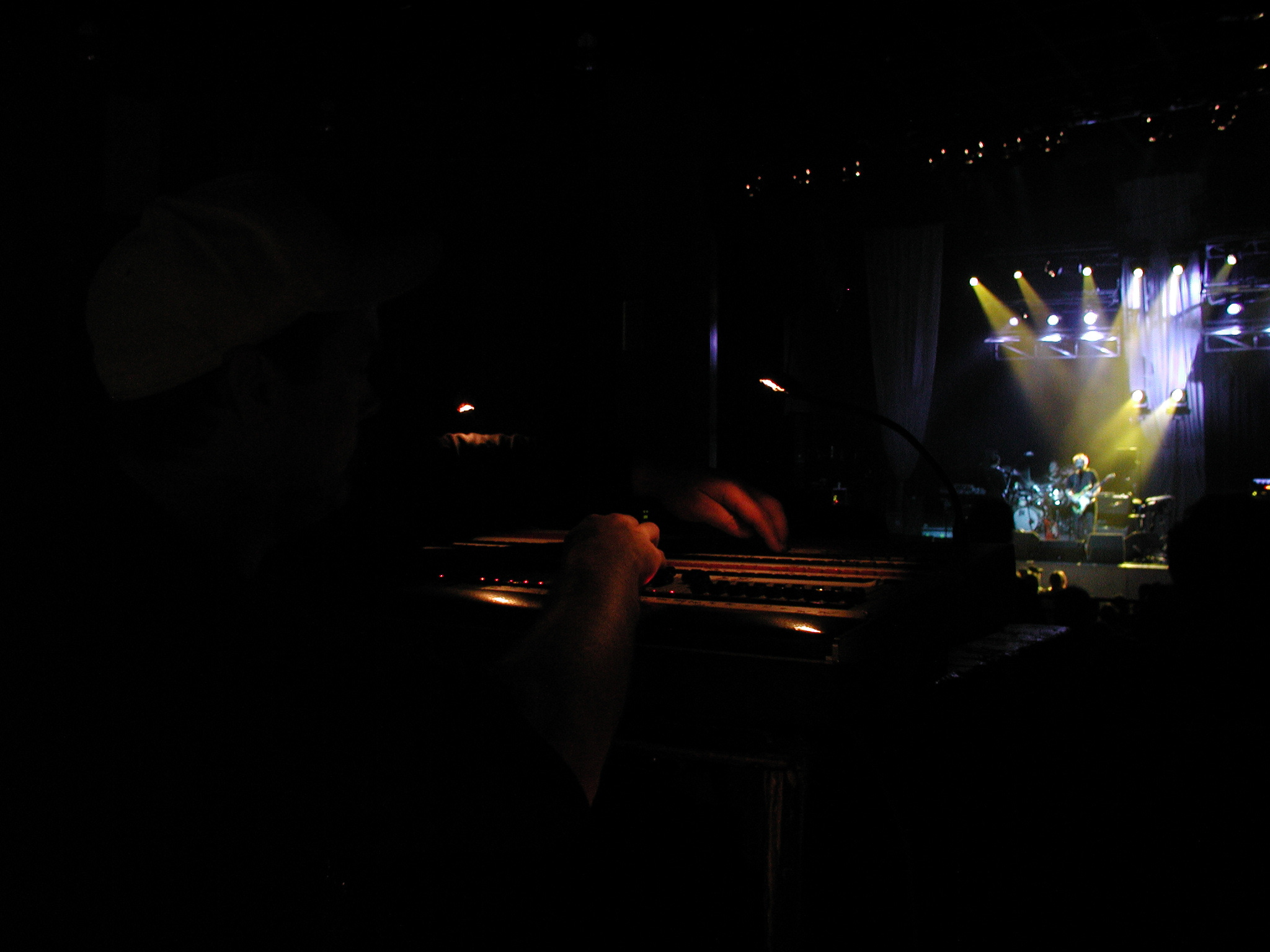
Photo: A view from the mixing desk. King Crimson 2001 Tour. Mexico.
The Knoxville theatre: fin de siecle restored-ish, with Bela Fleck the next act in a month’s time. Knoxville doesn’t seem to be on the primary touring circuit. The sound onstage was much, much better than Bogart’s. Perhaps this is surprising to audients, but much of sonic life onstage is a battle with bevoomeration and noise, and trusting in the sound mixer. We are very fortunate in Paul.
Paul’s door to Music was through London in 1968, which connected his core to the powerful creative download that being made through rock music in that period. The music of the time continues to resonate with him. Paul eventually left the industry, pretty well for the same reasons I regularly retreat from it, and is now a ski instructor in Colorado, inter alia. Pat the Beastly Propulsion Unit of Terror has worked with Paul and suggested he tried this Crim.
It struck me at the sound check that mixing, for Paul, is more an act of conscience. So, backstage after the show last night, I asked him if this was true (without quibbling too much about what me might understand as “conscience”, but I paraphrased to Paul as “true to your deepest essence”). His quick answer was “yes”. This is why he has a hard time in dud venues (like, almost all of them). When he can’t “feel” a mix, because of the wash of frequencies, he has to make an “intellectual” mix - as at Bogart’s. This seems to hurt him. Feedback suggests most audients comment favourably on the sound. The Guestbook even has one posting from a helpful sonic advisor at Bogart’s, the Rhythm Buddies tell me.
[Excerpt from RF’s King Crimson Touring Diary – July 25th. 2001]
I don't know how you guys do it, but in Brazil I worked with this guy in 2004, I believe his name spells Fejao (Brazilian nickname I assume) : we were playing a room/theatre that could sit aorox 1000 people. First thing he did: set up, monitors on, our instruments in our monitors, monitor mix done, he came on stage. Only THEN he approached the sound of the room. I thought "this makes so much sense!”. 22 years later, I haven't met a single sound engineer that does the same thing.
In my very limited experience, as well as the variability of the kit, the structure and dynamics of the room and separately, the dynamics of the stage is the varying degree to which band members are experiencing or attending to the quality and clarity of the sound. It's more often than not a mess but a decent engineer unravels it like a tangled ball of string.