
Sharing is consensual between all parties…
Words 52 · RF@80 Series.

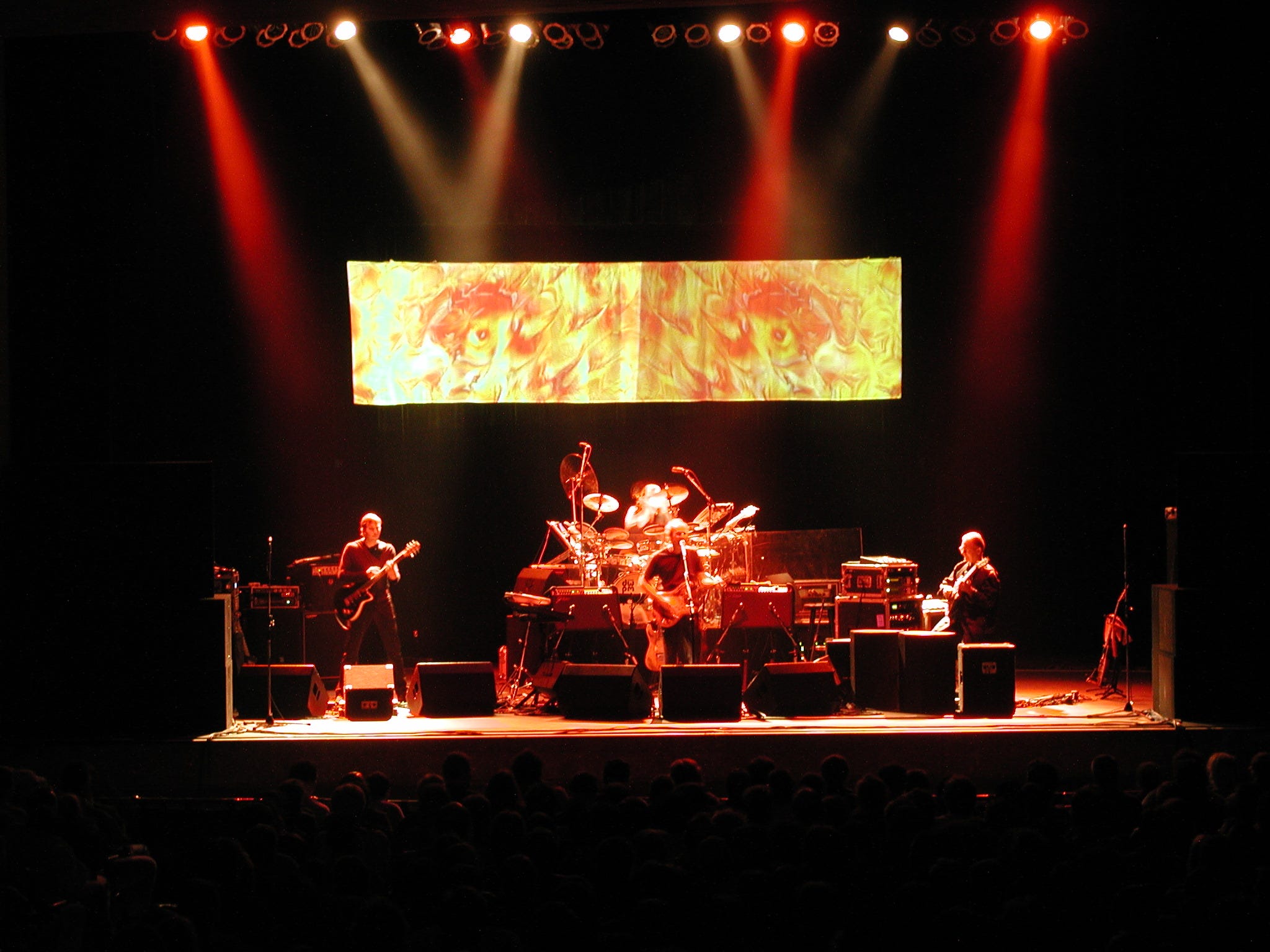
Photo: King Crimson at Paramount Theater, Asbury Park, USA. November 11th 2000.
RA: I really wanted to share the show with as many people who can download it.
RF: The act of sharing is one I welcome and respect. It is part of the essential and instinctive impulse of being a human being. But sharing is more subtle than the “sharing” frequently referred to in contemporary media.
1. Sharing is consensual between all parties. Any “contribution” made without the full consent of any party constitutes a form of violence, and undermines the integrity of the act.
2. We can only share what is ours to give away. King Crimson’s performances do not belong to Mr. Abbott, nor are they his to give away. His implicit claim and / or assumption, that in some way he has the authority to do so, is dishonest and arrogant; alternatively, self-delusory.
3. What Mr. Abbott may legitimately share his experience of the performance. But for this experience to be of any value, Mr. Abbott would have to have “been there” in some substantive or qualitative fashion. I see no indication of this in his posting: he is a spectator, not a participant. He gives nothing, has no intention of giving, and receives in return the measure of his own contribution. Not prepared to leave it there, he then makes available to others what is not his to give.
4. King Crimson’s performances do not, in any real way, belong to King Crimson either. A performance event “belongs” to whoever attended to it; that is, to whoever “was there” for it. This is contributory and participative. In this qualitative sense, Mr. Abbott undermines the audience as much as he undermines the group. And, although he hasn’t seen this yet, he also undermines himself. This one small act of living his life is how Mr. Abbott lives all of his life. This is terrifying.
5. To the degree that we pretend the results of a musical activity is “product”, the tangible outcome of a process, then the “ownership” rests with the artist. This carries with it a responsibility, which for my part I accept. I see in Mr. Abbott’s posting no indication that he accepts responsibility for his actions. Rather, the reverse.
6. Mr. Abbott’s action – illicit recording - undermined the performance. He then claims that this enabled him to “share” it. But why compromise something of value you want to share with others?
[Excerpt from RF’s King Crimson Touring Diary - May 17th. 2000]