
Active involvement and active listening…
Words 52 · RF@80 Series.

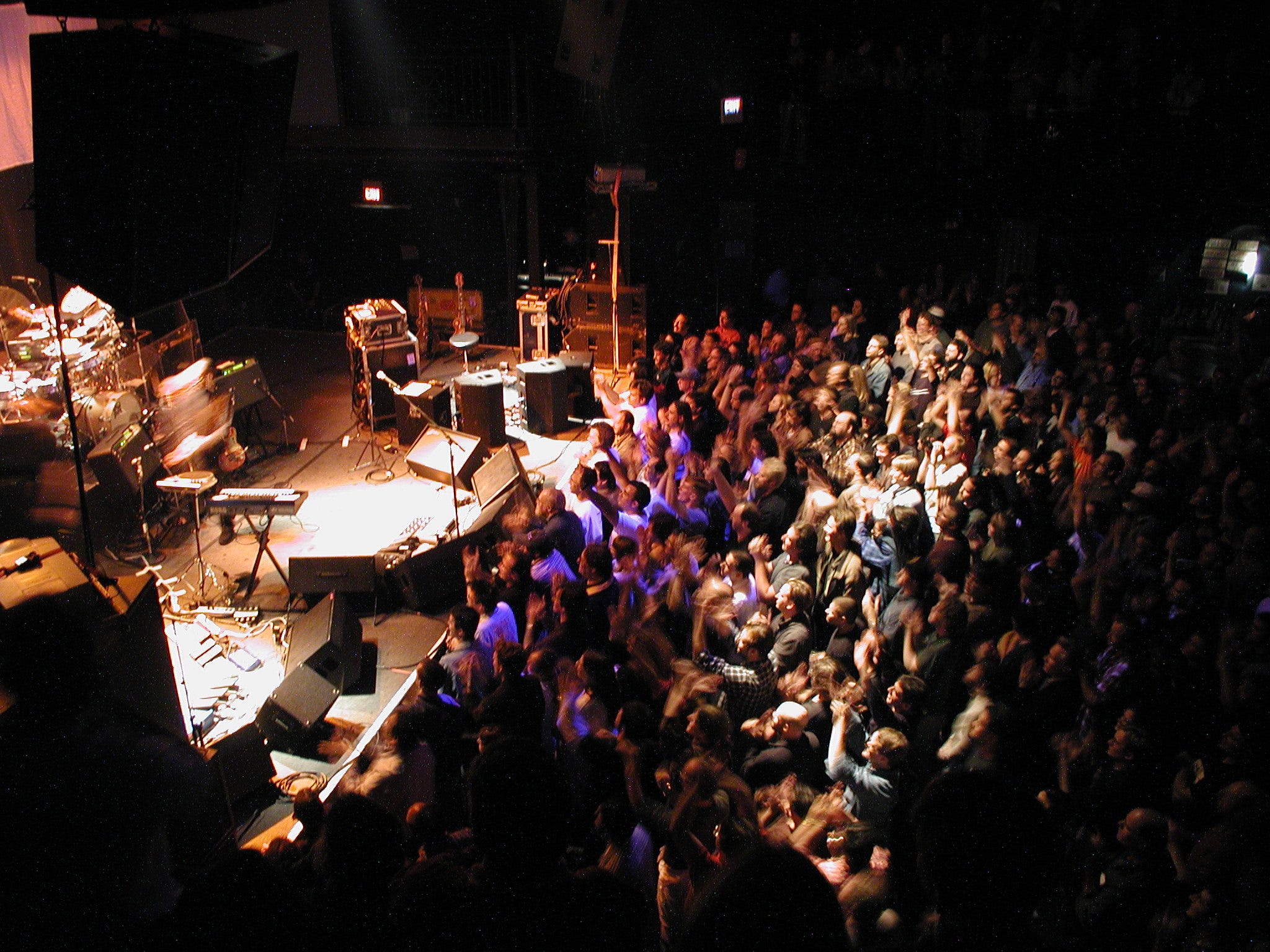
Photo: the audience at King Crimson’s performance November 8th. 2000. 9.30 Club. Washington, USA.
We hear what we believe we are hearing.
We see what we believe we are seeing.
When the disjunction between what we see and hear, and what we believe we are seeing and hearing, becomes too great, analytical mind presents us two choices:
1. What I see & hear is untrue;
2. What I believe I am seeing and hearing is untrue.
So, for analytical die-hard Crimson fans, the disjunction is growing. Their choices are:
1. This is not Crimson!
2. What I believe Crimson to be is not!
When the disjunction is too great, there are other choices. One of these choices is: Do nothing.
While doing nothing
Relax
Breathe
Be
Entertain goodwill
Suspend verbal intellectual thinking Listen
Watch
Then, perhaps, this moves to: Seeing
Hearing
That is
I am part of the event
I am part of the music
The music is part of me
This is a whole
This is a unity
This represents a shift from the “quantitative” and analytical perception of what is happening – a linear sequence of discrete, separate players & actions – to a “qualitative” perception of a whole event unfolding, of which I am a part. We are in relationship:
Music – Musician - Audience
Music – Audience – Musician
Musician – Music - Audience
Musician – Audience – Music
Audience – Musician – Music
Audience – Music – Musician.
This cannot be experienced analytically. It may be experienced intuitively.
An experience of this: I hear the music speaking to me, directly, personally. When this happens, actually, the music is speaking to me impersonally.
Nothing has changed in terms of what is happening – the “content” of the musical event, what is available to the senses, is as before. What has changed is the mode and quality of my perception of what is happening.
“Shifting perceptual modes” is hard enough as it is: this requires our active involvement and active listening. When a significant element in the whole is acting to undermine the possibility that the “shift” might take place, our undertaking is prejudiced. “Lift off” might not be possible with leaks in the fuel tank; deliberately creating leaks is harder still.
Relationship is determined by the degree of “togetherness”. In musical performance, photography and recording are forms of “untogetherness”. If we do experience this as fact, rather than a bright idea, performance in our commercial culture is a form of ongoing heartbreak.
[Excerpt from RF’s King Crimson Touring Diary - September 21st. 2000]