
Act always in accordance with conscience...
Words 57 · RF@80 Series.

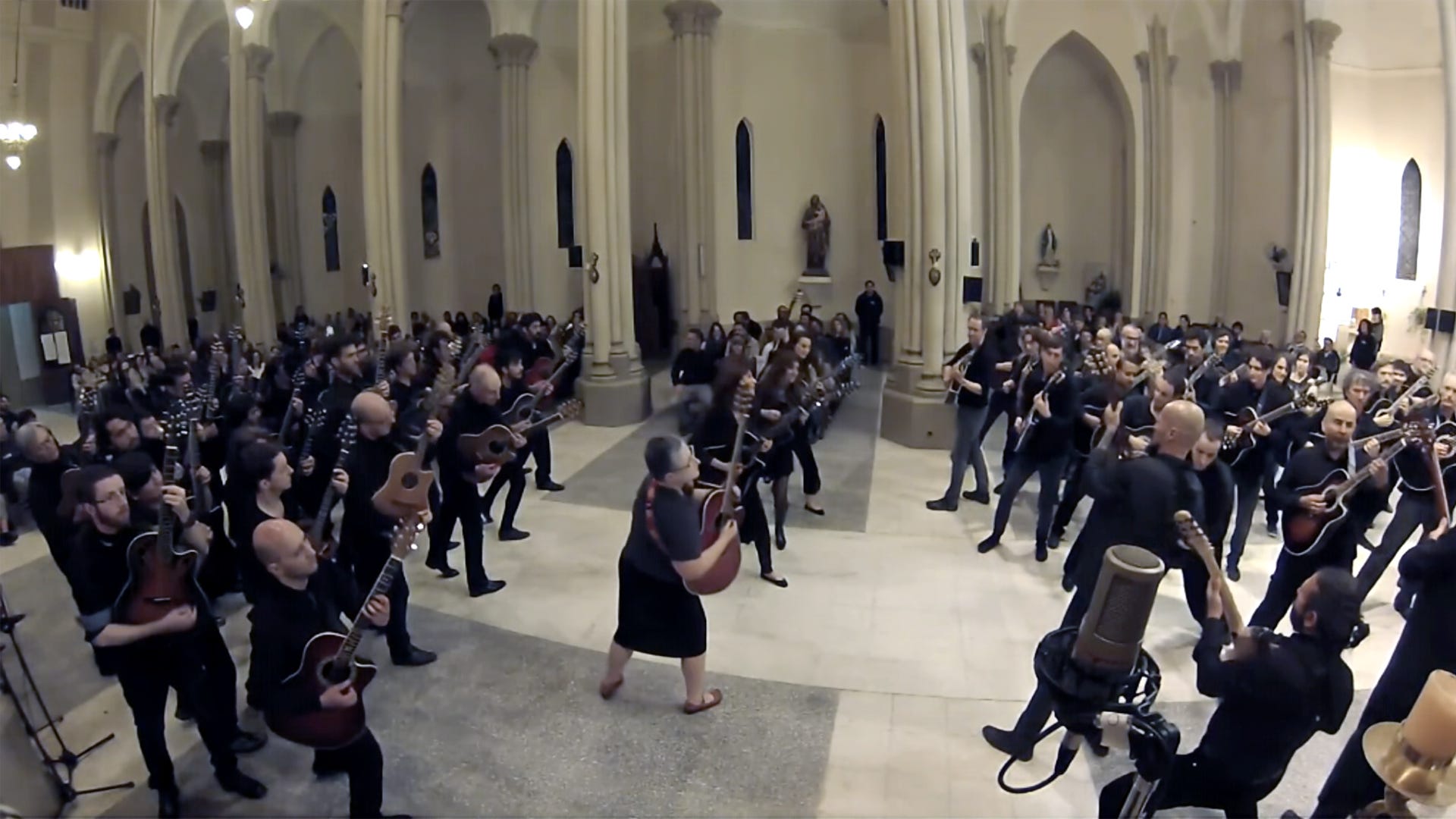
Photo: Robert Fripp & The Symphony Of Crafty Guitarists II - October 20th, 2016 - Villa Allende, Córdoba, Argentina.
DW: Robert, would you consider the following examples to be theft
1. The radio is on. The DJ is playing some good music. I can’t listen to the whole show because I (pick one): have to get in the shower, go to my neighbor’s house, go to work. So, I turn on the tape recorder and I record the part of the radio show of which I am unable to listen. Then, when I return home that night, I listen to the show. One of the songs is TCOL. Did I steal it? What if I listened to it only once? what if I listened to it twice?
2. I purchased the TCOL CD. My car has a CD player. But, it’s currently broken. So, I make a tape of the CD to play in the car’s cassette player. When the CD player in my car finally is fixed, I destroy the tape. But, did I steal TCOL when I temporarily put it on cassette? (What if I kept the cassette and alternated between the CD and cassette, in my car?)
Just wondering.
RF: “Wondering” lacks the bite of necessity and therefore doesn’t provide quite enough energy for an answer worth having. So this one is on me.
1. Recently I read the comment of an Orthodox monk on how to behave in front of novel conditions. His reply was along these lines (my words): “The Gospels give us directions in how to live but can’t provide answers to all possible practical situations. So when you’re in a situation where you don’t know the right course of action, pray. Call on God for direction”.
Sounds like good advice to me. For those who have difficulty with religious traditions, this is a secular paraphrase:
We live by principle.
We abide by a code of conduct.
When applying a principle to practice, in facing a novel situation, we seek guidance.
We consult our conscience.
2. Several of the postings to the Guestbook and ET address the question: what is appropriate behaviour in front of a huge range of possible courses of action? DW’s questions, more generally, refer to having a code of conduct or practice. How may we determine Right Conduct when, in daily life, there are a proliferation of situations and choices to be made in them? We might approach the question this way:
Firstly, are there house rules or conventional solutions available?
Secondly, what is being asked of me here?
Thirdly, what principle is involved?
3. One of the pillars of my own code of practice, when considering a course of action, is to ask myself these questions:
What shall I do?
Why shall I do this?
How shall I do this?
Will I do this?
The last part requires our consent if we are to proceed. If I know that a course of action is against the expressed wishes of others, I have to be very careful whether I will act. Most likely, I will not give myself the necessary consent. To override the expressed wishes of others involves very considerable repercussions, results and consequences. These cannot be avoided: a tab is run which will be met, sooner or later.
So DW: what is your code? Briefly, if your question holds value for you, examine your intent. You know the “house rules” – is your action knowingly non-consensual? Is your action intentionally non-consensual (moving towards the lower basement)? Is there any intention to steal – “theft is never innocent” (Rodney Collin)?
A specific answer to your question will also be governed by who is asking the question. Is the person asking acting in a spirit of goodwill?
4. Another quick (and long) answer is this:
Act always in accordance with conscience (this injunction is a principle).
Then
If a person has no aspiration to act in accordance with conscience, this injunction is meaningless.
If a person is without conscience, this injunction is meaningless.
If a person acts without conscience, they will react against the injunction.
If a person acts in violation of conscience, there are inevitable repercussions:
these may take 14-21 years to arrive but, sooner, later, they will.
Each of these different qualities of guidelines – principles, codes, conventions / rules, laws – belong to different “worlds”.
If we act on principle, much of the rest is superfluous.
If we live by a code of conduct, much of the rest is superfluous.
If we abide by consensual rules, we are relatively free of major conflicts.
If we act non-consensually and in violation of house rules; or unfairly; or dishonestly; or in denial of respect for the legitimate rights and concerns of others: we set in motion a series of events which, eventually, will lead us to complain of how much the unfairness of life presses down upon us.
The history of EG Management and its collapse continues to instruct me, more so now than at the time.
5. Moving slightly sideways... Why would anyone “in their right mind” not act in accordance with conscience? A strong candidate for an answer is this: where there is drug damage.
Guitar Craft courses attract a wide variety of people from an equally wide variety of backgrounds - countries, cultures, religions, belief systems, social strata, talent, education, intelligence and wealth. Many have a history of drug and alcohol use. This is no impairment or handicap to being accepted for a course.
Some Crafties have come on courses as part of their clean-up programme. They are welcomed without prejudice or blame: I respect those who have the courage to face their demons and accept responsibility for their actions. The relevant Guitar Craft principle here is this:
There is no mistake save one: the failure to learn from a mistake.
Within the context of a course, and the challenges it presents, it is easy to see the effects of heavy drug use. For example: co-ordination between the head and the hands is radically prejudiced; a “greyness” in the personal presence; when looking into the eyes, there is a vast distance to traverse and, sometimes, no-one at the end to embrace; a dullness of response. But the effects can go farther than this.
A disturbing insight from an experienced Crafty: major drug users on GC courses appear to have lost a sense of conscience. This is a hard thing to say. Why would this become particularly apparent within a Guitar Craft context? Guitar Craft is very much a social organism, an “I” in many bodies. From my own (long) experience of watching and enduring (hard) drug use in others, I note that drugs empower the “me”.
Several long-term drug users within Guitar Craft have strongly disputed my comments. “Coffee’s a drug!” is one of the more prescient arguments that has been used to invalidate my views, as well as to justify the complainants’ regular and ongoing (soft) drug use.
I wonder: of those posters who are happy to declare their intention to act non-consensually in a Crimson context, how many have a significant drug background?
[Excerpt from RF’s King Crimson Touring Diary - August 24th. 2000]
This is such an important teaching. If we maintain a conscience, and act in accordance with conscience, we can live and create with more ease.
I see your point of view, but in my life I’ve met and worked with many people that used drugs, soft drugs, and some, just a few, were rude and harsh, but most of them were the nicest and delicate people you can find. You know, the love and peace nice, almost hippie, kind of people. Maybe it has more to do with personality and self education than with habits, but I don’t know.
Like you say, it’s all about acting consciously